Modern life is built for convenience, but it is certainly not built for the human body. Between hunching over laptops, staring down at smartphones, and sitting in traffic, our daily routines force our bodies into unnatural, prolonged postures.
Over time, this sedentary lifestyle wreaks havoc on your musculoskeletal system. Your chest muscles tighten, pulling your shoulders forward. Your hip flexors shorten from sitting all day, leading to lower back pain. Your hamstrings become stiff, and your neck carries the heavy burden of “tech neck.”
If you are constantly popping painkillers or complaining about feeling “stiff as a board” by 3:00 PM, you do not necessarily need a heavy medical intervention; you likely just need to move.
Implementing a simple, consistent stretching routine is the ultimate antidote to modern physical stagnation. In this comprehensive guide, we will break down the deep physiological benefits of mobility work and provide you with exactly 5 everyday stretches to relieve tension and boost flexibility in just 10 minutes a day.
The Science of Stretching: What Happens to Your Body?
Stretching is often treated as an optional afterthought—something you only do for two minutes before a heavy workout. However, dedicated mobility work is a vital pillar of holistic health.
When you stretch a muscle, you are doing much more than just pulling on tissue. You are engaging with your fascia, the continuous web of connective tissue that wraps around every muscle, bone, and organ in your body. When you do not move enough, this fascia becomes glued together, creating painful “knots” and limiting your range of motion.
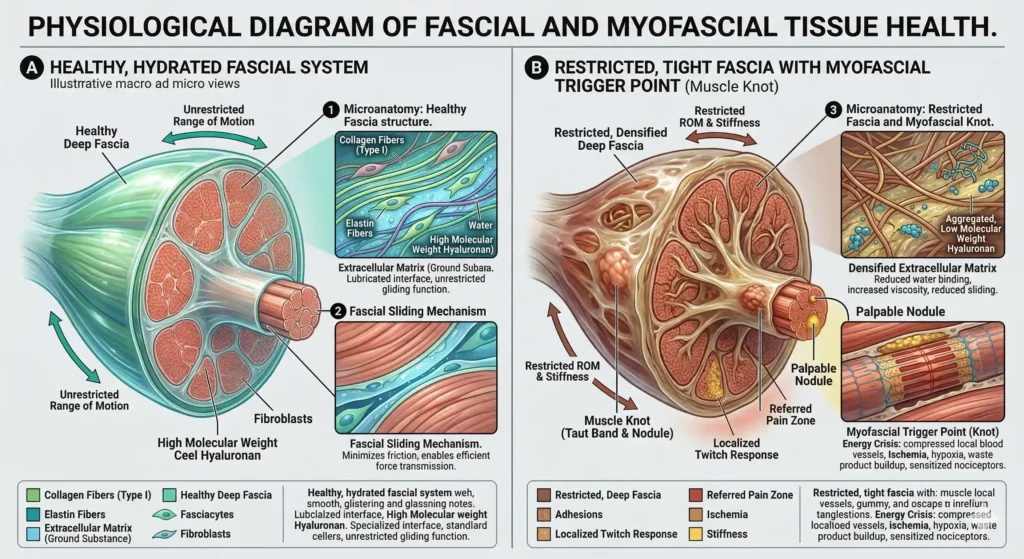
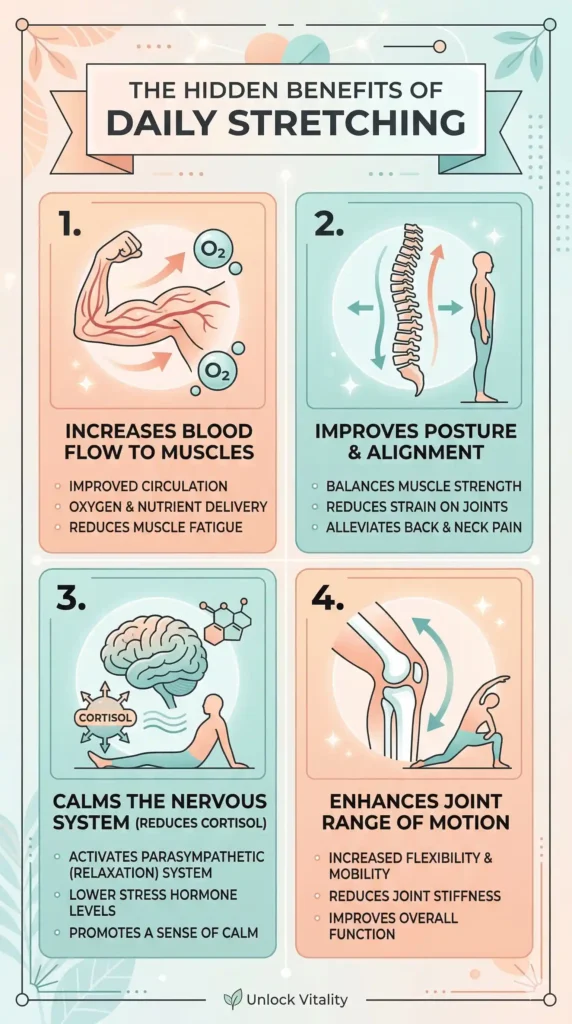
According to the experts at Harvard Medical School, stretching keeps the muscles flexible, strong, and healthy, and we need that flexibility to maintain a range of motion in the joints. Without it, the muscles shorten and become tight.
Furthermore, stretching triggers a parasympathetic nervous system response. Slow, deep stretching combined with intentional breathing signals your brain to lower cortisol levels, effectively reducing psychological stress while you melt away physical tension. If you suspect your physical tightness is linked to high anxiety, you can quantify your mental load using a stress level calculator to understand the mind-body connection better.
How to Stretch Safely and Effectively
Before we dive into the routine, it is crucial to understand the rules of engagement. Stretching incorrectly can lead to micro-tears in the muscle fibers.
- Never Stretch Cold Muscles: Always perform a light warm-up before static stretching. A brisk 5-minute walk or some gentle arm circles will push blood into the tissues, making them more pliable.
- Hydration is Key: Your fascia relies heavily on water to remain supple. If you are dehydrated, your muscles will feel stiff and prone to injury. Maximizing your daily water intake is essential; as discussed in our guide on the power of hydration, water is your best wellness ally for joint lubrication.
- Breathe Through the Hold: Never hold your breath while stretching. Inhale deeply as you prepare for the movement, and exhale slowly as you lean into the stretch.
- Find the “Edge”: You should stretch to the point of mild discomfort or tension, never sharp pain. If you feel a sharp pulling sensation, back off immediately.
The Core Routine: 5 Everyday Stretches to Relieve Tension
This sequence is designed to target the most common problem areas created by modern living: the lower back, the hips, the chest, and the neck. Perform these stretches daily, ideally in the morning to awaken your body or in the evening to decompress.
1. Child’s Pose (Balasana)
Target Areas: Lower back, hips, thighs, and ankles.
Why it works: Child’s Pose is a foundational resting posture in yoga that gently stretches the entire posterior chain (the back of your body). It is incredibly grounding and helps decompress the spine after a long day of sitting upright.
How to do it:
- Start on your hands and knees on a soft mat.
- Spread your knees wide apart while keeping your big toes touching behind you.
- Slowly sit your hips back onto your heels.
- Walk your hands forward on the floor and lower your chest and forehead to the mat.
- Take 5 to 10 deep, expansive breaths, feeling your ribcage expand and your lower back release.
2. Cat-Cow Stretch (Marjaryasana-Bitilasana)
Target Areas: Spine, neck, core, and chest.
Why it works: The spine is the superhighway of your central nervous system. The Cat-Cow sequence introduces fluid, dynamic movement to the vertebrae, stimulating spinal fluid circulation and melting away the stiffness that causes backaches.
How to do it:
- Begin on all fours in a tabletop position. Ensure your wrists are directly under your shoulders and your knees are under your hips.
- Inhale (Cow Pose): Drop your belly toward the floor, lift your chest, and look up toward the ceiling. Draw your shoulders away from your ears.
- Exhale (Cat Pose): Round your spine up toward the ceiling like a Halloween cat, tucking your chin to your chest and pulling your belly button in.
- Flow smoothly between these two poses for 10 to 12 breath cycles.
3. The Doorway Pectoral Stretch
Target Areas: Chest (Pectoralis major and minor) and anterior shoulders.
Why it works: If you spend hours typing or scrolling, your chest muscles inevitably shorten, causing your shoulders to slump forward. This stretch physically opens the chest cavity, correcting “hunched” posture and allowing for deeper, more oxygen-rich breathing.
How to do it:
- Stand in an open doorway.
- Raise your arms so they are bent at a 90-degree angle (like a goalpost) and place your forearms on the doorframe.
- Step one foot forward through the doorway.
- Gently lean your body weight forward until you feel a deep, opening stretch across your chest and the front of your shoulders.
- Hold for 30 to 45 seconds, breathing deeply. Switch your lead foot and repeat.
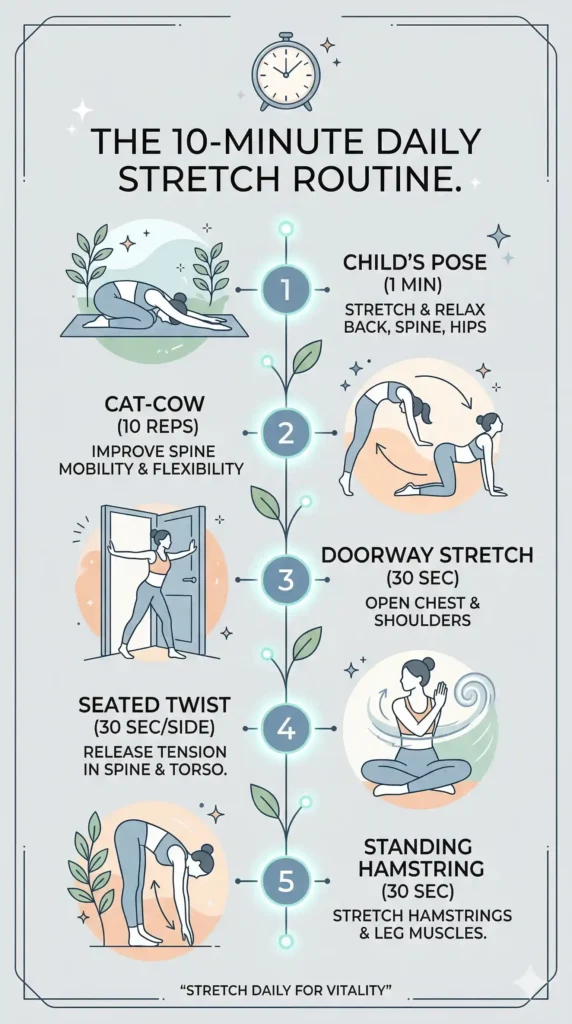
4. Seated Spinal Twist (Ardha Matsyendrasana)
Target Areas: Mid-back, obliques, hips, and neck.
Why it works: Twisting postures act like a wringing out of a wet towel for your internal organs and spinal column. This stretch restores rotational mobility to the spine, which is often lost when we sit in rigid chairs all day. It also aids in digestion by stimulating blood flow to the abdominal area.
How to do it:
- Sit on the floor with your legs extended straight out in front of you.
- Bend your right knee and cross your right foot over your left leg, placing it flat on the floor outside your left knee.
- Sit up as tall as possible, lengthening your spine.
- Inhale deeply. As you exhale, twist your torso to the right. Place your right hand on the floor behind you for support, and gently hug your right knee with your left arm (or hook your left elbow outside the right knee for a deeper twist).
- Gaze over your right shoulder. Hold for 5 deep breaths, then slowly untwist and repeat on the opposite side.
5. Standing Hamstring Stretch
Target Areas: Hamstrings, calves, and lower back.
Why it works: Tight hamstrings are the silent culprits behind a vast majority of lower back pain. When the muscles on the back of your legs are tight, they pull down on your pelvis, disrupting your natural spinal curvature. Releasing them brings immediate relief to the lumbar spine.
How to do it:
- Stand tall with your feet hip-width apart.
- Extend your right leg straight out in front of you, resting your heel on the ground with your toes pointing up toward the ceiling.
- Keep your back completely straight and hinge forward at your hips (do not round your back).
- Rest your hands on your left thigh for support.
- You should feel a deep stretch along the back of your right leg. Hold for 30 seconds, then switch legs.
Tracking Your Mobility and Vitality Progress
Stretching is not a one-time fix; it is a lifestyle habit. The key to seeing results—like being able to finally touch your toes or waking up without neck pain—is consistency.
As you incorporate these 5 everyday stretches to relieve tension and boost flexibility into your routine, you should start monitoring your overall physical energy. Are you waking up feeling less fatigued? Are your workouts improving? You can track these broader holistic health metrics using a vitality index calculator to see how improved mobility positively impacts your daily life.
Additionally, remember that tension is not limited to your back and legs. We carry an immense amount of stress in our facial muscles, often clenching our jaws without realizing it. Pairing your full-body stretching routine with targeted facial relaxation, like the techniques detailed in our ultimate face massage guide, provides a comprehensive, head-to-toe release of deep-seated tension.
The Bottom Line
The Mayo Clinic emphasizes that stretching can increase your flexibility, improve your performance in physical activities, and decrease your risk of injuries by helping your joints move through their full range of motion.
You do not need to spend an hour at a fancy yoga studio to reap these benefits. By dedicating just 10 minutes a day to these 5 essential movements, you will rapidly reverse the damage of a sedentary lifestyle. You will stand taller, breathe deeper, and navigate your day with a newfound sense of physical freedom and mental clarity.
Roll out your mat, take a deep breath, and start stretching the stress away today.
Frequently Asked Questions (FAQs)
-
When is the best time of day to stretch?
There is no single “best” time; it depends on your goals. Stretching in the morning helps wake up the nervous system and relieves overnight stiffness. Stretching in the evening is excellent for decompressing the spine and signaling to your body that it is time to relax and prepare for deep sleep.
-
Should stretching hurt?
Absolutely not. You should feel a deep, pulling sensation, which we call “tension” or “the edge,” but you should never feel sharp, stabbing, or tearing pain. If a stretch hurts, you have gone too far and risk injuring the muscle fibers or ligaments.
-
How long does it take to see an improvement in flexibility?
If you stretch consistently (4 to 5 days a week), you will likely notice a significant improvement in your range of motion within 3 to 4 weeks. However, consistency is critical; if you stop stretching, your muscles will gradually revert to their shortened, tight state.
-
Can I stretch if my muscles are sore from a workout?
Yes, but you must be incredibly gentle. Light, dynamic stretching can help increase blood flow to sore muscles, speeding up the recovery process. However, aggressive static stretching on severely delayed-onset muscle soreness (DOMS) can cause further micro-trauma.
-
Is bouncing during a stretch safe?
No. Bouncing during a stretch (known as ballistic stretching) can trigger a reflex mechanism in the muscle called the “stretch reflex.” This reflex actually causes the muscle to contract tightly to protect itself from tearing, which entirely defeats the purpose of the stretch and significantly increases your risk of injury. Always hold stretches statically and breathe deeply.