It’s the question every parent asks, usually with a mix of anticipation and panic: “Is it time yet?”
For young girls, the first period (medically known as Menarche) is a monumental milestone. It signals the transition from childhood to womanhood. But in 2026, the timeline of puberty is shifting. Girls are developing earlier than they did 20 years ago, leaving many parents confused about what is “normal” and what is a cause for concern.
Is 9 too young? Is 15 too old? And why does it seem like every girl in her class already has it?
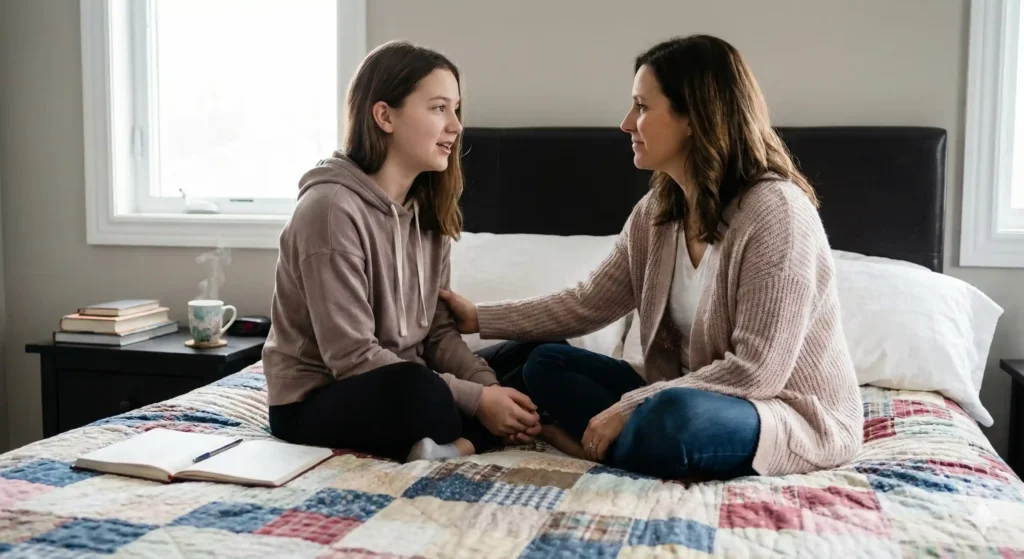
The internet is full of conflicting advice. At Gramonify, we believe in empowering you with medical clarity. In this comprehensive guide, we will break down the biological clock of puberty, the 5 signs that the first period is imminent, and how to build the perfect “Emergency Kit” so she never feels embarrassed.
1. The Magic Number: What is “Normal”?
Let’s look at the statistics first.
According to the American College of Obstetricians and Gynecologists (ACOG), the average age for a girl to get her first period in the United States is 12.4 years.
However, “average” is just a math number. The “normal” biological range is much wider.
- Normal Range: Between 10 and 15 years old.
- Early (Precocious): Before age 8.
- Late (Delayed): After age 15, or if it hasn’t happened within 3 years of breast development.
The Genetic Rule:
The biggest predictor of when your daughter will get her period is you (the mother). Ask yourself: When did I get mine? Chances are, she will start within a year of that age.
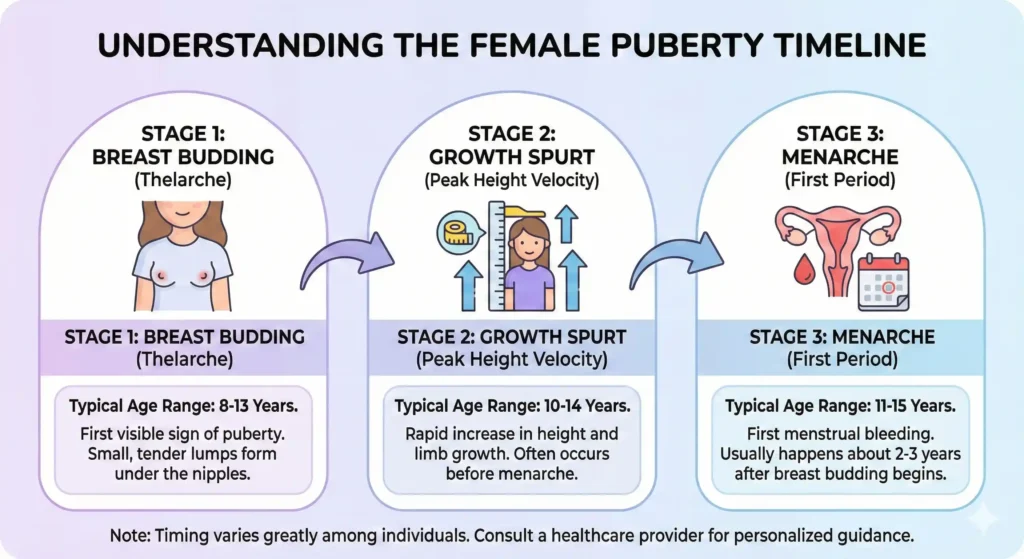
2. The Puberty Timeline: It’s a Sequence, Not a Surprise
The period doesn’t just appear out of nowhere. It is the final event in a sequence of hormonal changes. Doctors use the Tanner Stages to track this progress.
If you know what stage she is in, you can predict the period fairly accurately.
| Sequence | Event | Estimated Time to Period |
| Stage 1 | Breast Budding (Thelarche) | Small, tender bumps form under the nipple. This is usually the first sign of puberty (Age 8-11). |
| Stage 2 | Pubic Hair Growth (Pubarche) | Fine hair begins to appear. Usually follows breast buds closely. |
| Stage 3 | The Growth Spurt | Rapid increase in height (3-4 inches/year). Feet grow first. The body shape changes (hips widen). |
| Stage 4 | Vaginal Discharge | Clear or white fluid (Leukorrhea) appears on underwear. This is the uterus “cleaning” itself in prep. |
| Stage 5 | Menarche (First Period) | The grand finale. Ovulation may not happen for months, but bleeding begins. |
The Insight: If she just bought her first training bra (Stage 1), you have about two years. If she has noticed white discharge (Stage 4), you have about 6 months. Get the kit ready.
3. Why Are Girls Starting Earlier? (The 2026 Trend)
You aren’t imagining it—puberty is happening earlier. In the 1900s, the average age was 14. Now it is 12, and age 10 is becoming common. Why?
1. The “Adiposity” Factor (Body Fat)
The hormone Leptin, produced by fat cells, tells the brain, “We have enough energy to reproduce.” With childhood obesity rates rising, girls reach the critical “fat mass” threshold needed for menstruation sooner.
2. Endocrine Disruptors (Chemicals)
We live in a plastic world. Chemicals like BPA, Phthalates, and Parabens (found in shampoos, plastics, and receipts) mimic Estrogen in the body. This “fake estrogen” can trick the brain into starting puberty early.
3. High-Stress Levels
Studies suggest that girls growing up in high-stress environments (family conflict, absence of a father figure) may enter puberty earlier—an evolutionary response to “grow up fast” and leave the nest.
4. The 5 Warning Signs: How to Know It’s Coming This Week
The week before the very first period can be a rollercoaster. Watch for these physical and emotional cues:
The Pre-Menarche Checklist:
- [ ] The Discharge Change: Has the white discharge turned slightly brownish or pinkish? That’s “spotting.”
- [ ] The Mood Swing: Is she unusually tearful, angry, or sensitive? (More than typical teen angst).
- [ ] Acne Breakouts: A sudden cluster of pimples on the chin or forehead due to the progesterone spike.
- [ ] Abdominal Cramps: She might complain of a “weird stomach ache” or lower back pain, but not recognize it as cramps.
- [ ] Breast Tenderness: Nipples feeling sore or swollen right before the cycle starts.
5. Preparation: The “Just In Case” Kit
The biggest fear for any girl is getting her period at school and bleeding through her pants. Remove that fear by being prepared.
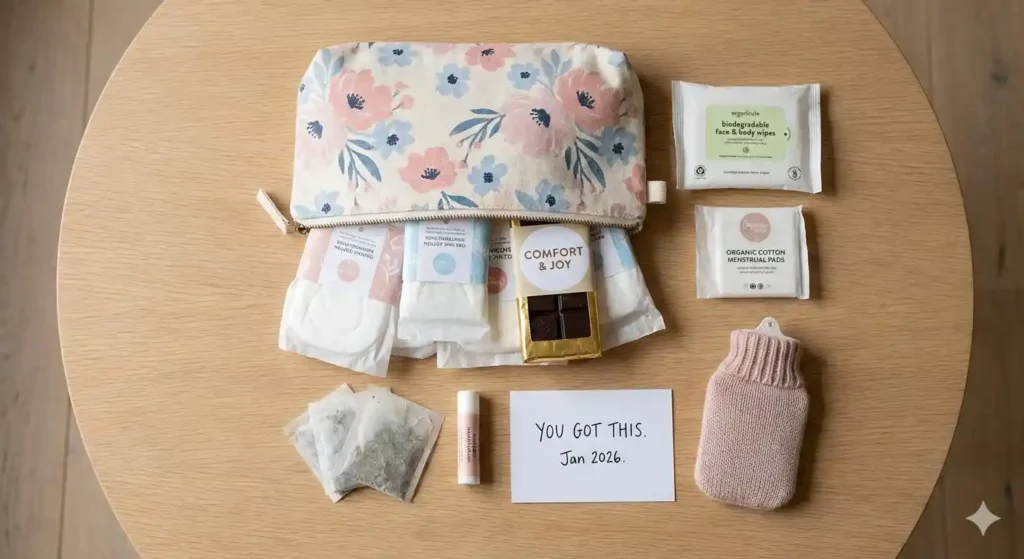
Create a “Period Kit” for her backpack:
- Pouch: A cute, discreet makeup bag (not clear).
- Pads: 2 thin “teen” pads (easier to use than tampons initially).
- Underwear: A clean pair of black underwear (hides leaks).
- Wipes: A small pack of intimate wipes.
- Chocolate: A small piece of comfort.
- Painkiller: Ibuprofen (if the school allows/nurse administers).
The Conversation:
Tell her: “If it happens at school, don’t panic. Go to the bathroom, put on the pad, and tie your sweater around your waist if there’s a stain. Call me, and I will come get you if you want.”
6. Tampons, Pads, or Cups? What to Start With
The aisle of feminine hygiene products is overwhelming.
| Product | Pros for Beginners | Cons for Beginners |
| Pads (Sanitary Napkins) | Best Choice. Non-invasive, easy to visualize flow. | Can feel “diaper-like” or bulky. |
| Period Underwear (e.g., Thinx) | Extremely comfortable. No fear of shifting. | Expensive. Requires washing out blood (can be squeamish). |
| Tampons | Good for swimmers/athletes. | Scary for first-timers. Risk of Toxic Shock Syndrome (TSS) if forgotten. |
| Menstrual Cups | Eco-friendly. | Too advanced. Requires comfort with anatomy and messy removal. |
Expert Recommendation: Start with Pads or Period Underwear for the first 3-6 cycles. Let her get used to the idea of bleeding before introducing invasive methods like tampons.
7. Red Flags: When to See a Doctor
While irregularity is normal for the first 2 years (the brain and ovaries are still syncing up), some signs require medical attention.
Consult a Pediatrician or Gynecologist if:
- Primary Amenorrhea: She is 15 and hasn’t started, OR she is 13 and has no breast development yet.
- Heavy Bleeding: She is soaking through a pad every hour for several hours.
- Long Periods: The bleeding lasts longer than 7 days.
- Severe Pain: Cramps that keep her home from school or cause vomiting. (This could be Endometriosis).
- The “Gap”: Periods occur more frequently than every 21 days or less frequently than every 45 days (after the first year).
8. Frequently Asked Questions (FAQs)
-
Will she stop growing after her period starts?
Not immediately, but the growth slows down significantly. Most girls grow only 1 to 2 more inches after their first period. The growth plates in the bones fuse due to the estrogen surge. This is why the major growth spurt happens before menarche.
-
Can she get pregnant right away?
Yes. Even if her periods are irregular, she can ovulate. It is crucial to have the talk about reproduction and biology now, even if she isn’t sexually active.
-
Why is the blood brown?
The first period is often not bright red. It is often brown or scanty. This is old blood that took longer to leave the uterus. It is completely normal.
-
How do I talk to my dad/single dad about this?
Dads, don’t be weird! Buy the products, leave them in the bathroom, and say: “I put some supplies in the cabinet. If you need anything else or want to see a doctor, just let me know.” Normalize it, don’t stigmatize it.
Conclusion: A Celebration, Not a Curse
In many cultures, the first period is treated as a secret shame. Let’s break that cycle.
This is a sign of health. It means her body is working exactly as it should.
Whether you celebrate with a “Period Party” (yes, that’s a thing now) or just a quiet hug and a heating pad, make sure she knows: This is powerful, this is normal, and she is supported.
Want to track the timeline? Check out our suggested health apps for teens in the resource section.