The human body is an absolute marvel of biological engineering, and nowhere is this more evident than in the female reproductive system. If you are trying to conceive, hoping to avoid pregnancy naturally, or simply trying to understand your own body better, you have likely found yourself asking: What does ovulation mean, exactly?
At its core, ovulation is the main event of your menstrual cycle. It is the brief, vital window of time when pregnancy becomes possible. Yet, despite how crucial this process is to human existence, many women are never taught the precise mechanics of how their own cycles work.
In this comprehensive guide, we are moving past superficial biology class definitions. We will explore the intricate hormonal dance that triggers ovulation, how to decode the subtle physical signs your body sends you, and how mastering your ovulation cycle can empower your overall health and family planning.
The Biology Behind It: What Exactly Is Ovulation?
To answer “what does ovulation mean,” we have to look inside the ovaries. Ovulation is the biological process where a mature ovarian follicle ruptures and discharges a fully developed egg (ovum).
Once released, this tiny egg embarks on a journey down the fallopian tube toward the uterus. It is here, in the fallopian tube, that the egg waits to be fertilized by a sperm.
However, the egg has an incredibly short lifespan. It can only survive for 12 to 24 hours after release. If it is not fertilized within this tight window, the egg dissolves, hormone levels drop, and your body prepares to shed its uterine lining—a process you know as your menstrual period.
But ovulation does not happen in a vacuum. It is the result of a highly synchronized communication loop between your brain and your reproductive organs. The hypothalamus in your brain sends a signal to your pituitary gland to release Follicle-Stimulating Hormone (FSH) and Luteinizing Hormone (LH), which ultimately command the ovary to release the egg.
Demystifying the Ovulation Cycle: The 4 Distinct Phases
It is a common misconception that the menstrual cycle is just the days you are bleeding. In reality, your period is just phase one of a continuous, month-long cycle. To truly grasp what ovulation means, you must understand the four distinct phases of the menstrual cycle.
According to the American College of Obstetricians and Gynecologists (ACOG), a normal cycle can range anywhere from 21 to 35 days. Let us break down what happens during this time.
1. The Menstrual Phase (Days 1-5)
This phase begins on the first day of your period. Because no fertilized egg implanted in the previous cycle, your body’s levels of estrogen and progesterone drop significantly. This hormonal shift causes the thickened lining of your uterus (the endometrium) to shed.
2. The Follicular Phase (Days 1-13)
Overlapping with your period, the follicular phase begins on Day 1 and ends with ovulation. Your pituitary gland releases FSH, which stimulates your ovaries to produce several small sacs called follicles. Each follicle contains an immature egg. As the days pass, one dominant follicle will emerge and grow larger, while the others dissolve. This growing follicle releases estrogen, signaling your uterus to start thickening its lining again in preparation for a potential pregnancy.
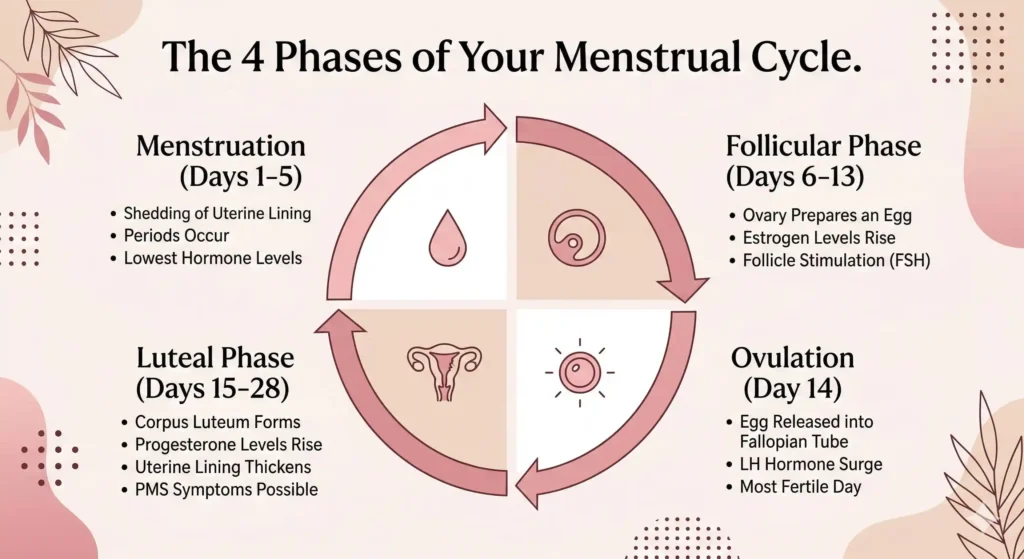
3. The Ovulation Phase (Day 14)
This is the main event. Rising estrogen levels from the follicular phase eventually trigger a sudden spike in Luteinizing Hormone (LH). This “LH surge” is the exact catalyst that causes the dominant follicle to burst open and release the mature egg. This phase is remarkably short, lasting only 12 to 24 hours.
4. The Luteal Phase (Days 15-28)
After the egg is released, the ruptured follicle transforms into a temporary endocrine gland called the corpus luteum. The corpus luteum pumps out high levels of progesterone, which stabilizes the uterine lining and makes it a welcoming environment for a fertilized egg. If pregnancy does not occur, the corpus luteum degenerates, progesterone plummets, and the cycle begins anew.
Timing is Everything: The “Fertile Window”
One of the biggest revelations for women learning about their cycles is understanding the “fertile window.” Since the egg only lives for up to 24 hours, you might think you only have one day a month to get pregnant.
Biologically, this is false. Sperm are incredibly resilient and can survive inside the female reproductive tract for up to five days under the right conditions (specifically, in the presence of fertile cervical mucus). Therefore, your fertile window actually spans about six days: the five days leading up to ovulation, plus the day of ovulation itself. Having intercourse during this window maximizes the chances of sperm waiting in the fallopian tubes exactly when the egg is released.
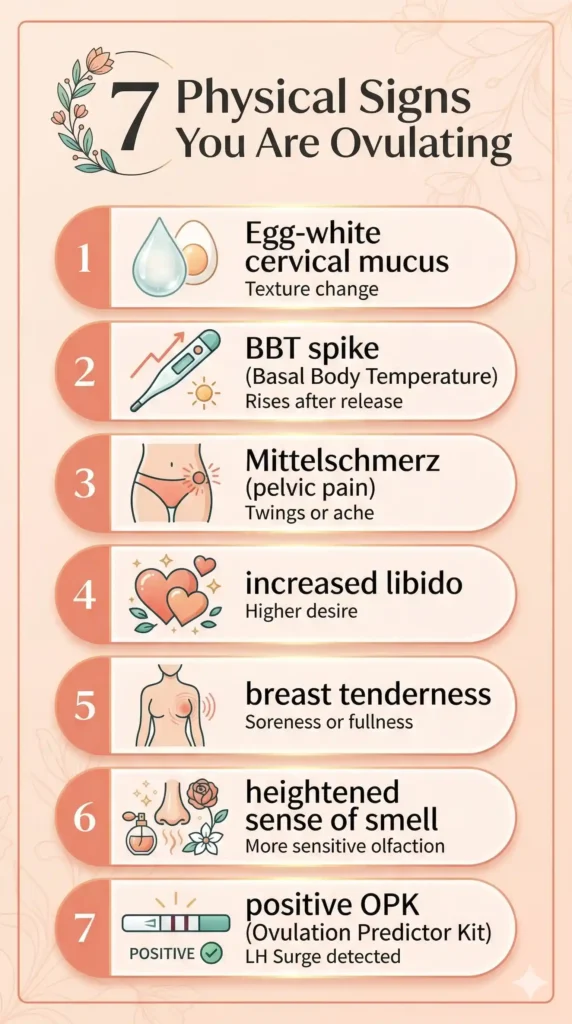
How to Tell if You’re Ovulating: 7 Undeniable Signs
Your body does not keep ovulation a secret; it broadcasts the event through several physical and physiological signs. If you tune into these signals, you can accurately pinpoint your most fertile days.
1. Changes in Cervical Mucus
This is one of the most reliable natural indicators. As you approach ovulation, rising estrogen changes the texture of your cervical mucus. It shifts from sticky and cloudy to clear, slippery, and stretchy—resembling raw egg whites. This “egg-white cervical mucus” is designed by nature to help sperm swim efficiently toward the egg.
2. Basal Body Temperature (BBT) Shifts
Your Basal Body Temperature is your body’s temperature fully at rest. If you track your BBT every morning before getting out of bed, you will notice a slight dip just before ovulation, followed by a sharp, sustained spike (about 0.5 to 1 degree Fahrenheit) immediately after ovulation. This spike is caused by the heat-inducing hormone progesterone.
3. Ovulation Pain (Mittelschmerz)
About one in five women experience a localized, sharp, or cramping pain on one side of their lower abdomen during ovulation. This phenomenon is known as Mittelschmerz (German for “middle pain”). It is believed to be caused by the swelling or rupturing of the follicle.
4. Increased Libido
Evolution plays a heavy hand here. As you approach your most fertile days, the surge in estrogen and testosterone often leads to a natural, noticeable increase in your sex drive.
5. Breast Tenderness
The cocktail of hormones flooding your system right before and after ovulation can make your breasts feel heavy, sore, or tender to the touch.
6. Heightened Senses
Many women report a heightened sense of smell, taste, or even vision during their ovulatory phase. Your body is biologically priming you to seek out a mate, making you more sensitive to pheromones.
7. Positive Ovulation Predictor Kit (OPK)
For a data-driven approach, OPKs are highly effective. These over-the-counter tests work similarly to pregnancy tests but measure the LH in your urine. A positive OPK means your LH surge is happening, and you will likely ovulate within the next 12 to 36 hours.
Factors That Can Interrupt Your Ovulation Cycle
Sometimes, the intricate communication between your brain and ovaries gets disrupted, leading to delayed or absent ovulation (anovulation). Understanding these factors is crucial for your reproductive health.
- Polycystic Ovary Syndrome (PCOS): This is a common endocrine disorder that causes hormonal imbalances, preventing follicles from maturing and releasing eggs properly.
- Chronic Stress: Your hypothalamus regulates both your reproductive hormones and your stress responses. High cortisol levels can completely halt ovulation. If you are struggling with anxiety, taking the time to measure and manage your mental burden using a stress level calculator can be a vital step in regulating your cycle.
- Nutritional Deficiencies: Your body requires adequate energy and nutrients to justify the “expense” of reproduction. Severe calorie restriction or a lack of macronutrients can stop ovulation. Ensuring you are well-nourished is key, and utilizing tools like a free protein intake calculator can help you optimize your diet for hormonal balance.
- Thyroid Disorders: Both an underactive and overactive thyroid can interfere with the hormones required for a healthy ovulatory cycle.
Experts at the Mayo Clinic emphasize that if you consistently experience highly irregular periods, or go months without a period, it is important to consult a healthcare provider.
Ovulation, Fertility, and Planning Your Family
Understanding what ovulation means is the ultimate tool for family planning. When trying to conceive, tracking your cycle takes the guesswork out of the process, reducing stress and increasing your chances of success.
It is also an exciting time for many couples. As you track your fertility, you might even find yourself looking into fun old wives’ tales, like researching the signs you’re having a girl or a boy based on the exact timing of conception. While mostly for fun, it adds joy to the journey!
Furthermore, tracking your cycles and overall health before conception pays off deeply during pregnancy and beyond. The healthier you are prior to ovulation, the better prepared your body is. This includes everything from testing for potential viral immunities using a CMV calculator to discussing your medical history with your OBGYN.
Ultimately, ovulation is a sign of vitality. A regular, healthy ovulation cycle is an indicator that your body’s systems are functioning in beautiful harmony.
Frequently Asked Questions (FAQs)
1. Can I ovulate twice in one month?
While you cannot ovulate at two completely different times in one cycle, you can release two eggs within a 24-hour period. This is how fraternal twins are conceived! Once that 24-hour window closes, rising progesterone levels completely block any further ovulation for that cycle.
2. Is it possible to have a period without ovulating?
Yes. This is called an anovulatory cycle. You may still experience bleeding that looks like a period, but it is actually “estrogen breakthrough bleeding” caused by a buildup of the uterine lining without the stabilizing presence of progesterone (which is only produced if you ovulate).
3. How long does ovulation pain last?
Mittelschmerz, or ovulation pain, is usually brief. It can last anywhere from a few fleeting minutes to several hours. Rarely, it may persist for a day or two. If you experience severe, debilitating pain, you should consult a doctor, as it could be a sign of endometriosis or an ovarian cyst.
4. Can stress really stop me from ovulating?
Absolutely. Severe emotional or physical stress triggers the release of cortisol and adrenaline. This signals to your brain that you are in a “survival” situation, prompting your hypothalamus to shut down non-essential functions—including reproduction and ovulation.
5. How soon after coming off birth control will I ovulate?
This varies wildly from woman to woman. Some women ovulate within weeks of stopping hormonal birth control, while for others, it can take several months for their natural hormonal rhythms to re-establish themselves.
Pingback: Eco-Menstruation: The Next Wave of Zero-Waste Period Heroes - Gramonify